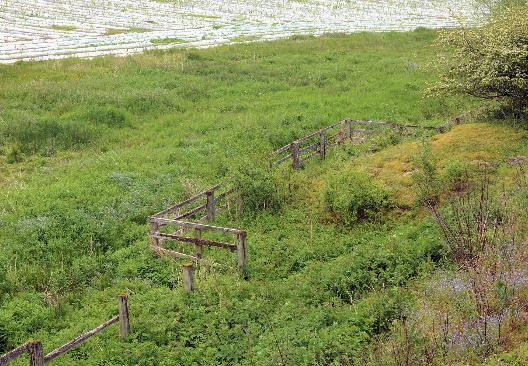
This is the site of a derailment where a wagon deposited its load of lime on the embankment. The vegetation on this patch is sparse compared to the surrounding areas. The large field on this side is used exclusively for crop growing, usually maize, and is a good place to see oystercatchers, lapwings and partridges in the spring before the crop grows too tall.
Once over the road bridge notice the group of farm buildings. These are Dike Nook, now the base of an agricultural engineering firm. Just behind the buildings the A66 is at this point following the course of a roman road, and nearby are the remains of a Roman temporary marching camp.
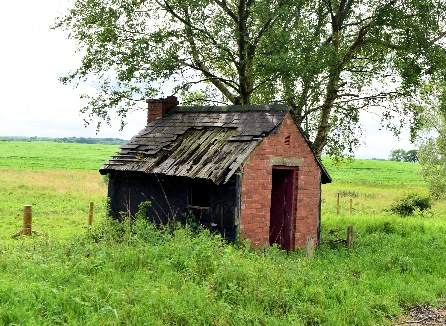
As the train enters Wildboar cutting the remains of another platelayers’ hut can be seen. The bulk of Wildboar Hill is apparent and some of the effects of the 2013 landslip can be seen on the hillside, below the fence.
We then come to the footpath crossing again. On this side the path goes to the A66 to buildings which are now known as Wheat Sheaf Farm, but which on an 1863 map were shown as Wheat Sheaf Inn, presumably a coaching inn.
The next footpath to cross the railway, at the Warcop end of the army camp, leads to the A66 close to Walk Mill. It used to continue up the fells beyond but this is now an army range with very little public access. The range opened in 1942 and now covers 24,000 acres. It is used for all weapons, from small arms to heavy artillery.
We then pass the Army sports field and helicopter landing area. Part-way up the fells can be seen an army command post on stilts, used for controlling activity on the ranges.
We then cross over to road to Warcop again and return to the platform. The old Station House is now in private hands – please respect the privacy of the owners.